VEX Robotics
During middle school, I was part of our STEAM club’s VEX Robotics team. Over two seasons, I led the robot’s software development and contributed heavily to its mechanical design and assembly.
VEX 2022-2023: Spin Up
This marked our school’s debut in VEX Robotics, coinciding with the first-ever official national tournament hosted in Belgium.
The game objective was to launch yellow foam discs into an elevated basket, spin field rollers to match your alliance’s color, and trigger an endgame mechanism to touch as many field tiles as possible for bonus points.
Building the Robot
I took the lead on mechanical design. Our setup was unconventional and a bit scrappy, but it proved remarkably effective. For the endgame, we engineered a string launcher capable of expanding across nearly the entire field in seconds.
Programming the Robot
For our first season, I programmed the robot using block-based coding (VEXcode Blocks). While straightforward initially, the visual workspace eventually became sluggish and cumbersome to navigate on my laptop as the codebase grew in complexity.
National Championship
We entered the Belgian national competition unsure of what to expect from other teams. To our excitement, our alliance went on to win the tournament—securing our ticket to the VEX World Championship in Dallas, Texas!
World Finals in Dallas
Traveling to Dallas to compete on the world stage in our very first season was an incredible experience. While we didn’t rank among the top global contenders, competing against elite international teams was an eye-opening masterclass in robotics engineering.
VEX 2023-2024: Over Under
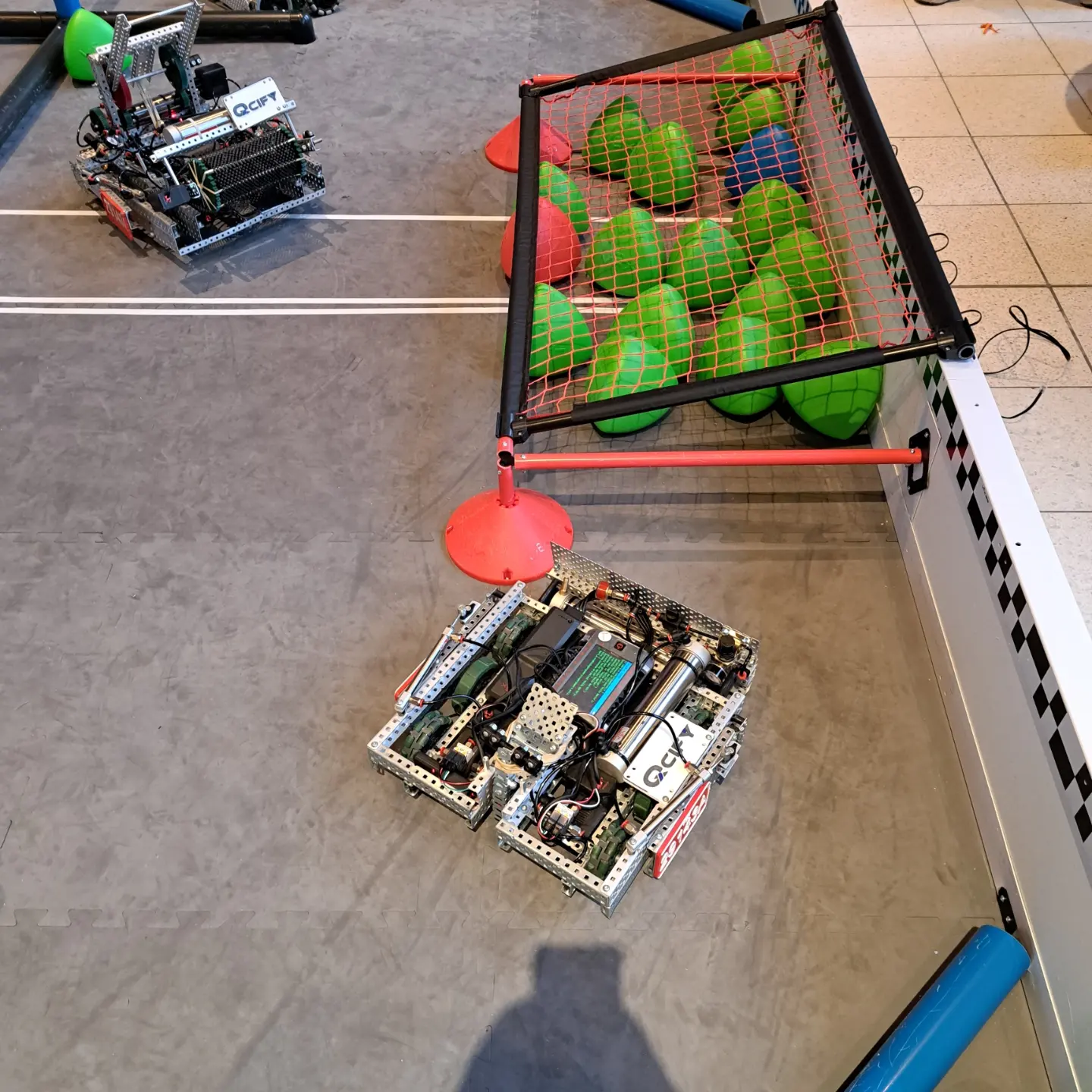
The following season introduced a new challenge: scoring acorn-shaped “triballs” into goals, climbing an elevated center pole during the endgame, and defending against opponent descoring maneuvers.
Following the previous year’s success, our robotics program expanded to include a second team formed by younger students.
Building “Mark E.”
We designed our robot—nicknamed Mark E.—around an aggressive offensive strategy. To slip underneath the goal barrier and rapidly descore triballs, we had to engineer an ultra-low-profile chassis, which presented tight packaging and mechanical constraints.
Programming the robot in C++
Determined to level up my programming skills, I abandoned block code completely. While I considered Python, my positive experience with low-level systems during an internship at Philips pushed me straight toward modern C++.
National Championship in Antwerp
The national tournament took place in Antwerp against significantly tougher competition. On game day, I was asked to take the controls as the primary driver. Despite the high-pressure matches, the robot handled reliably.
We advanced to the grand finals alongside our school’s junior team and took the title together! Because only one invitation to the Dallas World Finals was awarded, our junior team earned the spot to represent Belgium.
To this day, our school has maintained a flawless 3-for-3 streak in national championship titles.
Codebase
The code for Mark E. is open source on GitHub. Looking back at it today, it serves as a fun milestone showing just how much I’ve grown as a developer since then.