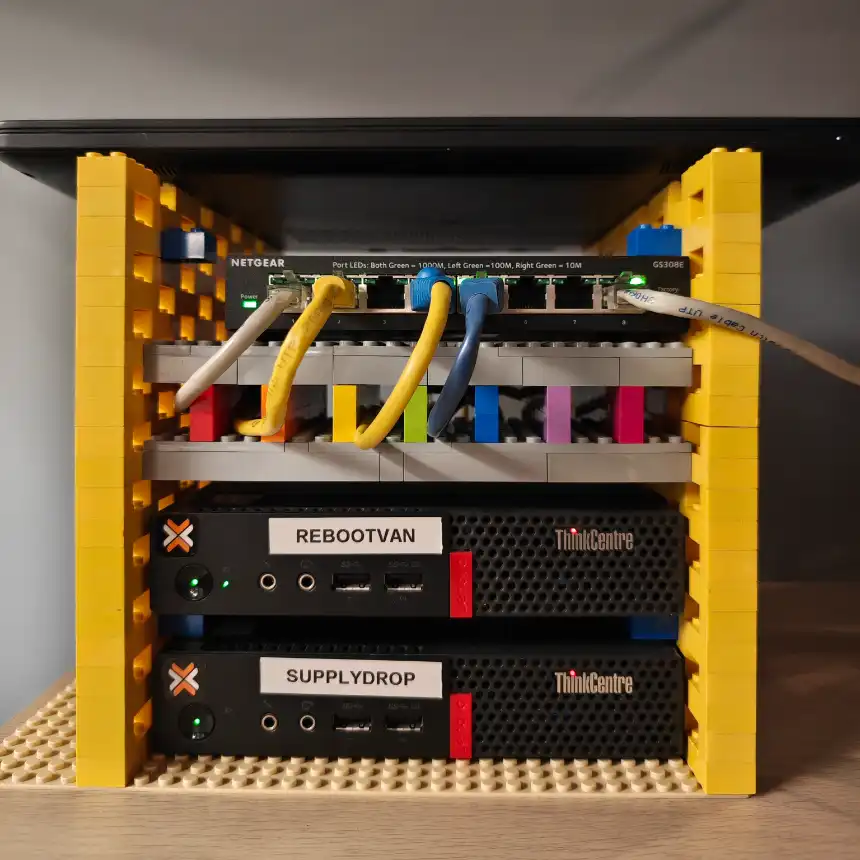
Declarative Infrastructure & Resilient Self-Hosting
What started on a single discarded laptop running Proxmox VE has evolved into a multi-node, reproducible homelab cluster. Instead of relying on brittle manual configurations, mental notes, or unversioned backup images, this infrastructure is engineered around a core philosophy: every server, container, and configuration must be 100% reproducible from Git.
By pairing NixOS and Proxmox with a dedicated OPNsense router, the entire homelab operates like modern cloud infrastructure—declarative, isolated, and restorable from scratch in minutes.
Architectural Challenges & Declarative Solutions
1. The Zero-Backup Dilemma: Declarative GitOps with NixOS
- The Problem: Without enterprise NAS appliances or secondary offsite backup servers, traditional hypervisor backups were an impractical luxury. A dead drive or broken configuration update would mean hours of manual rebuilding.
- The Solution: Fully declarative GitOps using Nix Flakes, Disko, and sops-nix. System states, package sets, firewall rules, and container definitions are tracked in a single Git repository and easily sharable between systems.
- Instant Recovery: Disk partitioning and filesystems are defined as code
via Disko. Secrets are encrypted with Age keys and safely committed to Git. If
any node suffers complete hardware failure, spinning up an identical
replacement takes a single
nixos-anywherecommand.
2. Hardware Evolution: ThinkCentres, Battery-Less Laptop & 3-Node Quorum
- The Problem: Consumer laptops make okay-ish starter servers, but their firmware lacks basic server capabilities—most critically, the ability to automatically power back on after an AC power failure. Furthermore, leaving an aging laptop battery plugged into mains 24/7 represents a severe swelling and fire hazard.
- The Solution: Primary compute duties were migrated to compact Lenovo ThinkCentre mini-PCs configured with hardware-level “Power On After AC Loss” forming the core compute workhorses.
- De-Batteried Laptop as a 3rd Quorum Node & Router: An older Dell laptop was repurposed, but with its battery physically removed to eliminate fire risk. Instead of running bare-metal, the laptop runs Proxmox VE as the third physical cluster member. This provides the essential odd-numbered vote for Corosync quorum, preventing split-brain scenarios across the cluster. Inside this node, OPNsense runs virtualized in a dedicated VM, delivering isolated routing and firewall protection. It was also a laptop that supported “Power On After AC Loss”, ideal for a router.
3. Blast Radius & Security: Network Segmentation & Zero Open Ports
- The Problem: Hosting public-facing projects (like GoStrategy and World Wide Bulb) while running experimental homelab services risks exposing private home devices if the network is flat.
- The Solution: Physical and logical network segmentation via OPNsense. The
entire homelab runs within an isolated subnet (
192.168.10.0/24), separated from my home network. - Zero-Trust Access: No router ports are forwarded to the public internet:
- Public Ingress: Handled by edge gateways running Nginx and Cloudflare Tunnels.
- Private Management: Admin interfaces and internal nodes are accessed through an encrypted Tailscale mesh subnet router, enabling secure, wireguard-speed access from anywhere in the world.
4. Workload Density & The Fortnite Ecosystem
To maximize CPU efficiency and memory utilization across the cluster, workloads are partitioned between lightweight NixOS LXC containers (for core daemons) and dedicated KVM Virtual Machines (for production isolation and non-Linux systems).
Servers are named after Fortnite POIs, structured into distinct functional clusters:
- Core Infrastructure & DNS (
adguard-home): Redundant dual AdGuard Home instances providing local split-horizon DNS resolution, malware filtering, and ad-blocking. - Edge Ingress (
battle-bus): Reverse proxy gateway managing Nginx and routing traffic through encrypted Cloudflare Tunnels. - Telemetry & Observability (
lonely-lodge&lobby): Centralized telemetry stack running Dockerized Grafana, Loki, Promtail, and Prometheus, complemented by a Homepage dashboard and automated health checks via Gatus andntfy. - Internal Logistics & Media (
greasy-grove&risky-reels): Kitchen and inventory management through KitchenOwl and Homebox, alongside media streaming with Jellyfin. - Application Environments (
retail-row&salty-springs): Dedicated production and staging environments hosting full-stack applications running in Docker containers.
Operational Automation with Just
Day-to-day maintenance is automated with a centralized justfile. Rolling
updates across the entire server farm, rebuilding individual LXCs, or checking
encrypted secrets can be executed locally or remotely with a single command:
# Rebuild all homelab targets in parallel
just rebuild-all --parallel

# Verify and audit Age secret encryption
just check-secrets